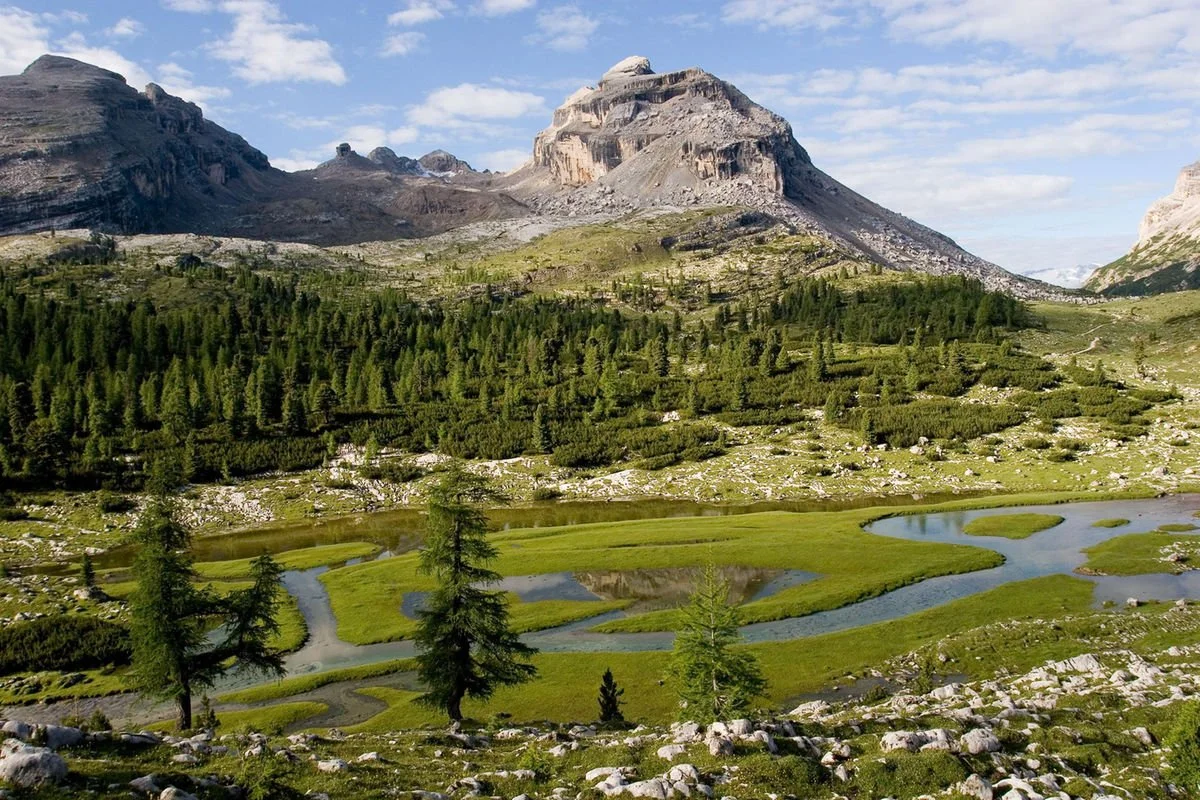
Following the route of the transhumance when it 'desmunta', i.e. descends into the valley, our route also takes us further down towards the altitude of 1800 metres and to the Fanes entrance: the Lavarella refuge, the Green Lake and the Limo Lake. This is also the entrance to a mythical area, that of the Fanes Kingdom, so rich in legends and the Ladin 'contíes'. So rich that we leave it up to you to delve into them through the links you will find here, as well as through a few keywords: the kingdom of marmots (in this very area there is a particular rock formation that is called the 'parliament of marmots'!), Dolasilla, Moltina, Spina de Mul, Ey de Net. In addition, Ladin myths tell of the 'ganes', the 'salvans', the 'malans', the 'pavarò', the 'Orco da La Val', the 'Bau', in short, the multifaceted population of the Ladin forests and folklore stories. Prof. Ulrike Kindl, a former associate professor at the Cà Foscari University of Venice and an expert on Alpine folklore and Ladin-speaking linguistic minorities, writes that the importance of legends is that they are "bearers of an extraordinarily effective symbolic thought, which narrates the Dolomite world of ancient times but which can only be understood through precise interpretations”.Finally, the toponym Fanes is also mysterious; some scholars say the word is of pre-Latin origin. The root could be in the Gothic language, or in the word fani-, which in the Romansh language of Switzerland still means 'quagmire, marsh'. In fact, water is abundant in Fanes, as the lakes in the area show.
Insights
https://parchi-naturali.provincia.bz.it/parco-naturale-fanes-senes-braies.asp
https://it.wikipedia.org/wiki/Regno_dei_Fanes
https://it.wikipedia.org/wiki/Fanes
https://en.wikipedia.org/wiki/Kingdom_of_Fanes
www.ladinia.it/it/informazioni/397/ladinia/il-regno-dei-fanes
www.visittrentino.info/it/articoli/unesco-dolomiti/dolomiti/leggende-i-monti-pallidi
https://wikisource.org/wiki/Proverbi,_tradizioni_e_anneddoti_delle_valli_ladine_orientali
Maps & Logistics
Lavarella Hut:
Accessible by car-van, preferably jeep-pickup or WD
Spherical Images
Fanes:
https://goo.gl/maps/EaZK7TTtDu4KxHFi6
https://goo.gl/maps/bpqaTBAmqjUuWoQZ7
https://goo.gl/maps/34n6FERqDBeCsFTt7
Lake Verde:
https://goo.gl/maps/sCNgKMme2k7jtg4PA
Lake Limo:
SMACH References
Ed. 2021

Ed. 2019
Ed. 2017