I visited the Museum Ladin Ursus ladinicus. I was very curious, as I have a great fondness for bears, even though I am afraid of them.
When I went hiking in Trentino last summer, I read the information leaflet several times about how to respect the bear's territory and what to do if a bear attacked me. I don't think there's anything wrong with being afraid. Sometimes, I think, that is part of respecting nature. We humans are part of it too. We should not try to place ourselves above it, as Aldo Leopold's land ethic suggests. Still, secretly, I hoped I might catch a glimpse of one. Unfortunately...
Now I am standing face to face with a bear, only this one is no longer alive.
In front of me stands a bear skeleton, surrounded by skulls of different bear species. I am allowed to touch the skulls, to feel the differences in the shape of the bones. My hand glides over the head as if I were gently stroking a tame dog, one after another. Good boy!
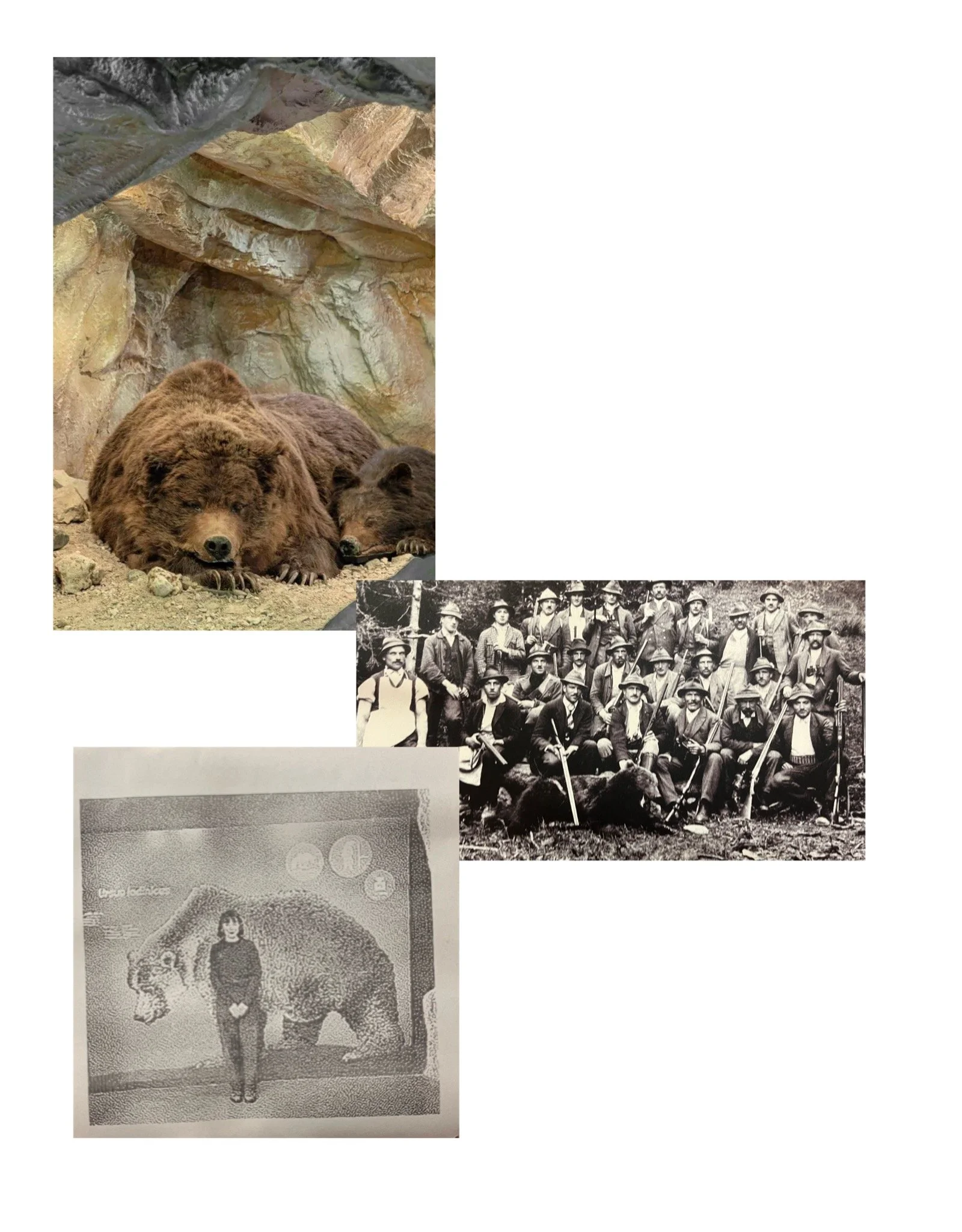
The Ursus ladinicus was discovered in a cave. In 1987, Willy Costamoling discovered a cave full of bones. After further research, scientists established that they belonged to a previously unknown species of cave bear. These bears were enormous and had a pronounced bend in their necks, as if they blended into the mountain horizon. It is also remarkable how these bears managed to move around and find food in the mountains. But the friendly guide pointed out to me that the climate was different back then and that vegetation often reached right up to the caves: alpine flowers, grass. What's more, the bear was mainly a planteater, feeding on flowers and leaves.
The bear was a herbivore. That little sentence stayed with me, and my heart gave a little leap.
As if, for him too, it was more ethical not to eat meat, and to drink herbal tea from the mountain meadows with me. Sadly, the Ursus ladinicus is extinct, but last summer a new cave was discovered, containing even more remains. Both the guide and I were very enthusiastic. Through the window, he showed me the spot on the mountain where the cave was located.
At the end of the tour, we stood in front of a stuffed brown bear. Next to it sat a gigantic teddy bear on a chair. I imagined it was waiting for visitors to return so they could give it a hug. The other bear was dead. The guide told me that it had been hit by a car.
I asked him about the issue of bears in Italy. Between 1999 and 2002, ten bears from Slovenia were released into the wild as part of the Life Ursus project, with the aim of restoring the bear population in the central Alps. Since then, the population has grown considerably, and the bears have spread across a larger area of the central Alps. Reports of bears coming into conflict with humans are becoming more frequent. In 2023, the first fatal attack since the reintroduction took place, claiming the life of a runner.
The guide told me that it was a difficult issue. In his view, those of us who don't live in an area where bears roam can easily say that we love bears. But if you live there, and it gets dark and you have to be careful on your way home, just as you are doing now, then of course it is a completely different story.
On the other hand he said; one person killed by a bear, over how many years? What are the figures for femicide in this country each year?